05 Plumbing
05 Plumbing
This is the wet day. Bucket, pump, manifold, solenoids, branches, emitters — in that order. Plan on about three hours. Keep paper towels nearby and a mug of hot water at the workbench; you’ll need both.
The order
You’ll work top-down through the system, from the reservoir out to the leaves:
- Pump and reservoir — bucket prep, pump prep, float switch.
- Pump output to the 6-way T — the only high-pressure connection in the system.
- The 6-way T manifold — four 1/4” solenoid feeds out of one fitting.
- Daisy-chain a second T (only if you have more than four zones).
- Solenoid valves — push-fit fittings, the most common leak source.
- Zone branches — barbed tees and drop lines from each solenoid.
- Emitters — one per small pot, two per big pot, every 12” along a raised bed.
- End caps — goof plugs everywhere a line ends.
That’s the spine. Each step gets its own H2 below.
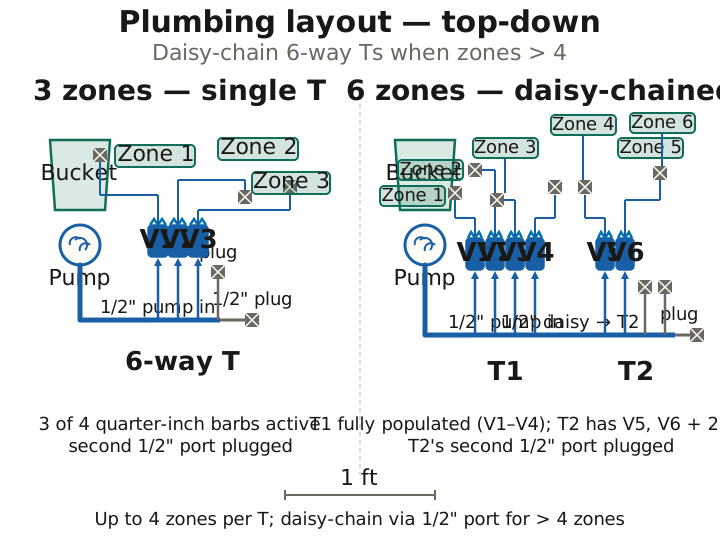
Step 1 — Pump and reservoir
- Take the lid off the 5-gallon bucket. Drill a 3/8” hole near the edge (not centered) for the supply tubing. Drill a second 1/4” hole next to it for the pump’s power cable.
- Wrap the pump’s 1/2” threaded outlet with three or four turns of teflon tape, clockwise as you face the threads. If your pump’s output doesn’t fit the 6-way T’s 1/2” barb directly, screw on a 1/2”-to-1/4” barbed reducer hand-tight, then a quarter turn with pliers. Don’t overtighten — the reducer is plastic and the pump body is plastic.
- Lower the pump into the bucket. Thread the supply tubing up through the 3/8” hole and the power cable through the 1/4” hole. Snap the lid back on.
- Seal both holes from the outside with silicone sealant. Press it around the tubing and cable. Let it cure for two hours before you fill the bucket.
- Place the bucket at the same height as your pots or slightly above — set it on an upturned pot or a small crate if your pots are elevated. The pump can push water three meters vertically, but level-or-above means more even flow to every emitter.
- Take one float switch out of the 3-pack and check it on continuity mode with your multimeter: tilt it up, beep; tilt it down, no beep. Mount it inside the bucket so the float drops once water level reaches the last inch (below the pump intake). You’ll wire it on the 12V positive line on page 08.
Why seal the lid holes? Two reasons. Mosquitoes lay eggs in standing water — an open reservoir on a balcony in July is a wriggler factory. And an open bucket loses about a quart a week to evaporation in summer sun. Two minutes of silicone solves both.
Step 2 — Pump output to the 6-way T
- Cut a short length of 1/2” tubing — six inches is plenty if your pump sits next to the manifold, more if you’ve got slack in the run. Dip one end in hot water for ten seconds.
- Slide a mini hose clamp onto the tubing before you push it on. You can’t add a clamp after a fitting is seated.
- Push the softened end onto the pump’s outlet (or onto the 1/4” reducer barb if you needed one). It should slide on about 3/4”.
- Tighten the hose clamp over the barb with a small Phillips screwdriver. This is the single highest-pressure connection in the whole system — the pump pushes against everything downstream of here. Clamp it properly.
- Dip the other end in hot water and push it onto one of the 6-way T’s two 1/2” barbs. Clamp this one too.
The pump now feeds the manifold directly. There’s no separate “main supply line” — the 6-way T is the manifold, and the pump goes straight into it.
Step 3 — The 6-way T manifold
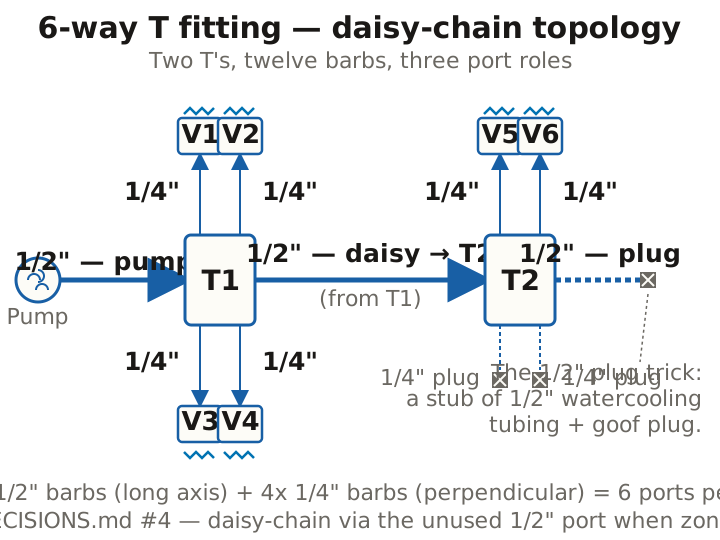
The 6-way T has six barbs total. The two big ones are 1/2”: one is your pump-in (you just connected that in step 2), the other is the daisy-chain port for step 4 — or it gets plugged. The four small ones are 1/4”: one per solenoid valve. The planner has already done the math: n_six_way_ts = ceil(n_zones / 4), n_unused_quarter = (n_six_way_ts × 4) − n_zones. Buy that many goof plugs; you’ll thank yourself.
For each zone you have:
- Cut a short piece of 1/4” tubing — about three inches.
- Dip one end in hot water for ten seconds, push it firmly onto one of the four 1/4” barbs. The tubing should slide about 5/8” onto the barb.
- The other end goes into the inlet side of a solenoid valve in step 5 — leave it loose for now.
Then, for any 1/4” barbs you aren’t using on this T (zones 1, 2, or 3 with one T means 3, 2, or 1 unused barbs), push a goof plug into each one. Same hot-water dip, same firm push.
Step 4 — Daisy-chain if you have more than 4 zones
For 5 to 8 zones, you’ll use two 6-way Ts. Take the second 1/2” barb on T1 (the one you didn’t use for the pump), connect a length of 1/2” tubing — softened, clamped — to one of the 1/2” barbs on T2. The other 1/2” barb on T2 gets plugged. Now T2’s four 1/4” barbs are available for solenoids 5 through 8, exactly the same way T1’s were.
For 9 to 12 zones, add T3 the same way. The planner counts everything: how many Ts, how many 1/2” plugs, how many goof plugs for unused 1/4” barbs.
Why not just use bigger T fittings? Because “6-way T” is what’s actually sold for irrigation manifolds at this scale. Going bigger means moving to a sprinkler-grade manifold, which is overkill (and overpressure) for capacitive-moisture-driven low-flow drip. Daisy-chaining 6-way Ts keeps everything in the 1/4” hobby-irrigation ecosystem.
Step 5 — Solenoid valves and push-fit fittings
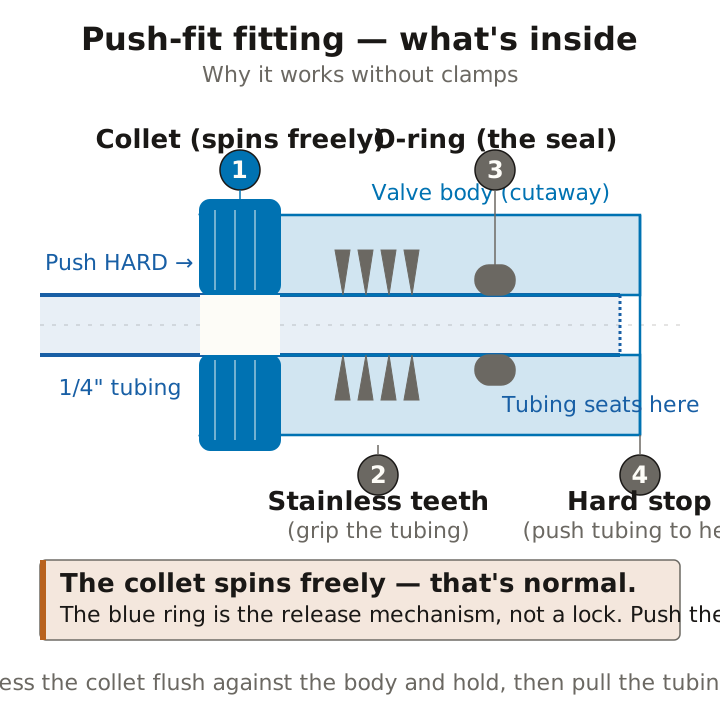
Each solenoid valve has two push-fit fittings — INLET (marked with an arrow toward the body) and OUTLET (arrow pointing away). Note the flow direction. Water flows in the direction of the arrow.
Label each valve with masking tape: V1, V2, V3, etc. — match these to your zone numbers from the planner.
For each solenoid:
- Take the 1/4” tubing line you ran from the manifold’s 1/4” barb in step 3. Cut the end clean and square — kitchen scissors squash the tube oval, so use a sharp utility knife or a proper plastic tubing cutter.
- Push the cut end into the solenoid’s INLET fitting. Push hard — until the tube physically refuses to go further. Then tug back lightly to set the teeth.
- The blue ring will spin freely. That’s normal. Don’t twist it expecting it to lock; it doesn’t.
- Cut a fresh piece of 1/4” tubing for the zone branch (step 6 covers length). Square-cut both ends, dip the OUTLET end in hot water (push-fit fittings on the outlet side are still push-fit, but the dip helps), and push that into the solenoid’s OUTLET fitting the same way.
The blue ring isn’t a lock. Common reasons your push-fit leaks (ranked):
- Tube not pushed in far enough. Most common cause. The tube enters in stages: past the stainless teeth (light resistance), past the O-ring (firmer), then hits the hard stop at the back of the fitting. “Feels seated” usually means the O-ring isn’t engaged. Push HARD until it physically refuses to go further, then tug back lightly to set the teeth.
- Tube end mangled or not square. Kitchen scissors squash 1/4” tubing oval; it will never seal. Use a sharp utility knife or a proper plastic tubing cutter, perpendicular to the tube.
- Wrong tube size. 6mm vs 1/4” (6.35mm) is the classic mismatch — they look identical and never seal. Check the size molded into the fitting body.
- Wrong tube material. Push-fit needs semi-rigid tubing — PE, PU, or PEX. Soft silicone or thin-walled vinyl collapses under the teeth and never seals. Pinch test: holds shape = OK, squishy = won’t work.
Things NOT to try: PTFE tape on the tube (stops the teeth gripping), silicone sealant, superglue, any other adhesive. The fix is always: pull the tube, re-cut clean and square, push back in HARD.
Page 06 (leak test) is where you’ll discover which fittings need this — push-fit is the most common failure mode in the whole build.
To pull a tube out of a push-fit fitting (when you need to redo a leaking joint): push the blue collet IN toward the fitting body with one hand, then pull the tube straight out with the other. The collet pushes the teeth back so they release the tube. Cut a fresh clean square end before you push it back in.
Step 6 — Zone branches
From each solenoid’s OUTLET, run 1/4” tubing along the railing or pot row toward that zone’s first container. Measure the path with the tubing itself rather than guessing — leave six inches of slack on each run.
For each container along the zone:
- Cut the branch line at the container, insert a 1/4” barbed tee (dip both cut ends in hot water first).
- From the tee’s perpendicular barb, run a short drop line (about 10”) down into the soil.
- Push an emitter stake onto the end of the drop line and press the stake into the soil near the plant root.
- Continue the main branch line on to the next container in the zone, repeat.
After the last container in the zone, cap the branch with a goof plug (step 8 covers this).
The hot-water trick. Every barb connection — every push of 1/4” tubing onto a barb or emitter stake — gets dipped in hot water for ten seconds first. Without this, you will fight every fitting for an hour and probably split a tube. Cold tubing is rigid and won’t seat; hot tubing slides on, cools, and grips. Keep a mug of hot water at the workbench. If the water cools off before you finish a stretch, top it up — the trick stops working below about 60°C.
I figured this out around fitting 30 of 47 of my own build, which was the most expensive lesson of the whole project. Don’t be me; preheat the kettle.
Step 7 — Emitters
The emitter rule depends on the container:
| Container | Emitters | Why |
|---|---|---|
| Lettuce / radish / herbs (small pot) | 1 per pot | Shallow roots, narrow pot |
| Tomatoes / cucumbers / peppers (5-gal pot) | 2 per pot, opposite sides of the stem | Heavy drinkers, wide root ball |
| Raised bed (~3–4’ wide) | 1 emitter every ~12” along the row | Linear distribution along the line |
For small pots: position the stake about four inches from the stem, near the center. For 5-gallon pots: split the drop line with a second tee at the pot, run two drop lines on opposite sides of the stem, stake both about four inches out. For raised beds: run the line along the back edge of the bed (the side against the railing) just inside the soil surface, drop a stake every twelve inches.
Each emitter has an adjustment top — turn counterclockwise for more flow, clockwise for less. Starting points:
- Lettuce / radishes / herbs: about 25% open.
- Tomatoes / cucumbers / peppers: 40–50% open.
- Raised-bed mixed plantings: 35% open, then fine-tune individual emitters once you see how each part of the bed drinks.
You’ll dial these in during page 06 (leak test), so don’t agonize over precision now.
Step 8 — End caps
Cap the end of every zone branch with a goof plug. The planner already counted these — n_zone_endcaps = n_zones. Push-fit-style: dip the cut end of the line in hot water if needed (some goof plugs go onto a barb, some plug a fitting directly), push the plug in firmly until it bottoms out, tug to confirm.
If your last 6-way T’s daisy-out 1/2” barb is unplugged (unused 1/2” port), use a 1/2” plug or — Gus’s actual solution — a stub of 1/2” PVC watercooling tubing capped with a hose clamp. Either works; the planner’s BOM line n_unused_half = 1 accounts for this.
Goof plugs also go into any unused 1/4” barbs on the manifold T (covered in step 3) and any extra branch points where you cut the line and changed your mind. Keep a handful spare.
With the plumbing assembled, head over to page 06 to fill the bucket, direct-wire the pump, and find every leak before the electronics ever come out of the box.