07 Soldering and Wires
07 Soldering and Wires
If you’ve never crimped a quick-disconnect or soldered to a spade tab, here’s the 30-minute version. The relay-to-solenoid wiring on this build is your only mandatory crimp/solder; if you’re already comfortable with one of these techniques, skip the option you don’t want and read the wire-spec section. Advanced readers, by the toggle at the top of the site, skip this page entirely — the prev/next nav routes 06 → 08 for them.
Crimp or solder — pick one
Crimp-on quick-disconnects beat alligator clips on every axis: they hold against vibration, they don’t short to each other, and they pop off when you actually want to swap a valve. They’re detachable, which means a dead solenoid is a 30-second swap rather than a desolder job. The trade-off is one $25 ratcheting crimper that you’ll then use on every project for the rest of your life.
Soldering directly to the spade tab is bombproof and cheap if you already own a temperature-controlled iron, but it’s permanent — when the valve dies you’ll be cutting wires. The rest of this page treats crimp as the recommended path; an alternative-soldering section follows further down for readers who’d rather solder.
The minimum kit
About $55 once for everything you need. The crimper is reusable on every project from now on; the wire and quick-disconnects are consumable.
| Item | What to search | Cost |
|---|---|---|
| 100-pack 0.187” fully-insulated female QDs (red, 22-18 AWG) | “0.187 nylon insulated female disconnect 22-18 AWG” — Wirefy/Haisstronica | $8-12 |
| Ratcheting crimper for insulated terminals | “Haisstronica HS-9327” or “IWISS HS-1054” | $25 |
| 20 AWG stranded silicone hookup wire (multi-color) | “BNTECHGO 20 AWG silicone wire 6 colors” | $20 |
| 1N4001 diodes (flyback) | Any electronics retailer, buy 10 | $2 |
Why a ratcheting crimper, not the $5 stamped one from the hardware store? The cheap stamped crimpers squish only one side of the barrel and rely on your hand strength, producing crimps that look fine until vibration kills them in a month. A ratcheting crimper has matched dies that close both the conductor and insulation barrels at once and won’t release until full pressure is reached — repeatable, gas-tight, every time. $25 is the cheapest insurance you’ll buy on this build.
Wire spec — 20 AWG stranded silicone
20 AWG stranded silicone hookup wire is the right gauge for everything on this build. The QD terminal barrel is stamped 22-18 AWG; 20 AWG sits dead-centre of that range and crimps perfectly every time. Current load is around 300-800 mA per solenoid, which is a tiny fraction of the wire’s capacity.
Stranded vs solid
Stranded wire (lots of tiny twisted strands) deforms under the crimp barrel and grips properly. Solid wire (one thick rod) refuses to deform — it sits in the barrel mocking you until it works loose under the first vibration. Stranded only for crimp terminals; solid is for breadboards and house wiring inside walls.
Silicone vs PVC
Silicone is more forgiving for hobby work; PVC is fine if you keep the iron away from it.
| Property | Silicone | PVC |
|---|---|---|
| Flexibility | Excellent (stays soft) | Stiffens over time |
| Heat resistance | 200°C+ | ~80°C |
| Solder iron tolerance | Won’t shrink back if grazed | Can melt/shrink during soldering |
| Cost | ~50% more | Cheapest |
Color coding suggestion
Use a multi-color spool pack and apply consistent meaning across the build:
- Red for +12V (always positive supply).
- Black for ground.
- Yellow and blue for switched outputs from relay channels 1 and 2 to solenoids 1 and 2.
Future-you will thank present-you when something breaks at 11pm.
Crimping a quick-disconnect
Five steps per connection, about 90 seconds once you’ve got the rhythm:
- Strip about 5/16” (8mm) of insulation from the wire end.
- Twist the strands tight so they slip into the QD barrel as one bundle, not as a frayed mop.
- Slide the strands into the receptacle barrel until the wire’s insulation butts up against the insulation grip.
- Crimp once on the conductor section and once on the insulation section (or in one squeeze if your tool has both jaws).
- Tug-test it. Pull the wire with reasonable force. If it comes out, redo the crimp — there’s no salvage on a failed crimp.
Push the QD onto the spade tab on the solenoid; you’ll feel a positive snap. Done.
I crimped my first one badly because I had the strip length wrong — too much bare copper sticking out the front of the barrel, insulation grip biting on naked wire. The tug-test caught it before I closed the enclosure, which is the whole point of the tug-test.
Soldering to a spade tab (alternative)
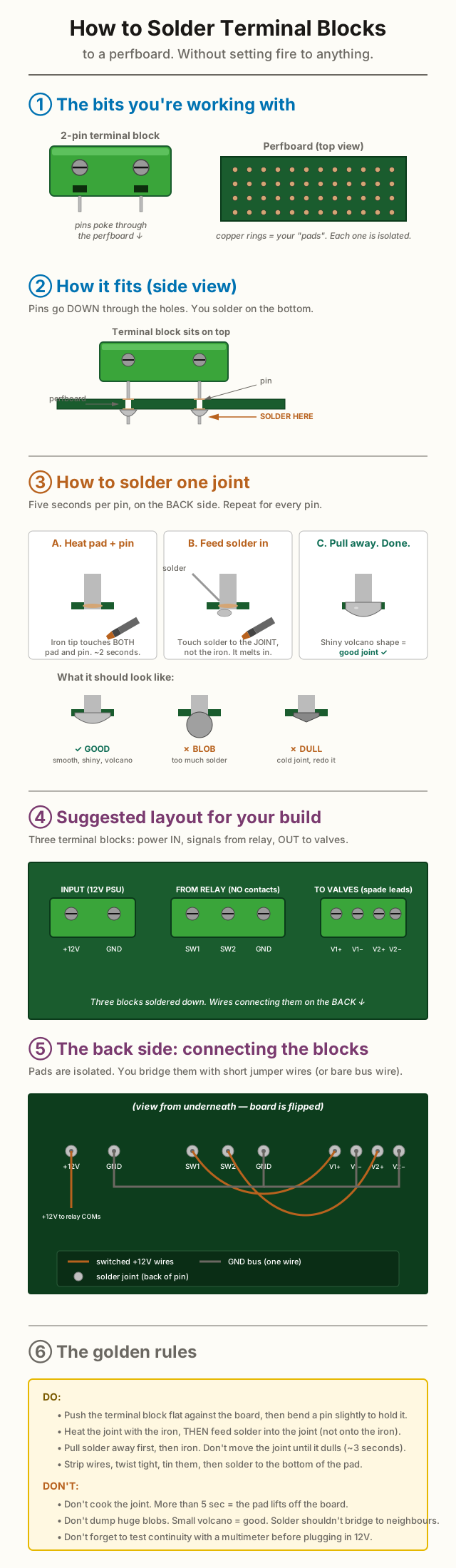
Iron requirements: 40-60W temperature-controlled, set around 380°C / 720°F, with a chisel tip at least 2.4mm wide to dump heat fast. A Hakko FX-888D, Pinecil V2, TS101, or even a $15 adjustable 60W pencil iron all work. A basic unregulated 25W pencil iron will make you suffer. Use rosin / no-clean flux and standard 60/40 or 63/37 leaded rosin-core solder; avoid plumbing/acid flux, which corrodes the joint over months.
Procedure: slip a piece of heat-shrink onto the wire first and shove it well clear of the work area. Strip and tin the wire end. Flux the spade tab and pre-tin it with a quick 3-second dab of solder. Lay the tinned wire against the tinned tab, touch the iron to both for about 3 seconds while feeding a tiny bit of fresh solder, then pull the iron away. The joint should look smooth and shiny, not a dull blob. Slide the heat-shrink down over the joint and zap it with a heat gun.
Heat-shrink sizing: 1/4” (6.4mm) 3:1 adhesive-lined (“dual-wall”) is the right call for outdoor wet-environment work — it shrinks tight over both the wire and the wider tab area, and the adhesive provides strain relief plus a moisture seal. Plain 2:1 in 3/16” (4.8mm) is fine for indoor builds where you don’t need waterproofing.
If you forgot to thread the heat-shrink onto the wire BEFORE soldering, the only fix is to cut the joint apart, slide the heat-shrink on, and re-solder. Don’t try to slip a smaller-diameter heat-shrink over a finished joint — it will not fit. Source-archive line: “everyone forgets this once and curses themselves.” I’ve cursed myself twice.
The flyback diode
Each solenoid coil is an inductor. When you cut its current (relay opens), the magnetic field collapses and induces a high-voltage spike that arcs across the relay contacts and slowly destroys them. A 1N4001 diode wired across the coil — cathode (the striped end) to +12V, anode to ground — gives that spike a clean path to dissipate as heat instead. Cheap insurance; mandatory on every solenoid in this build.
Mount the diode either at the relay (the NO terminal to ground via the diode) or directly across the coil with its own QDs piggybacked on the solenoid’s terminals. Either works; pick whichever is easier in your enclosure. Page 08 walks the actual placement.
Relay and PCB screw terminals — the other end
The other end of the wire goes into your relay module’s screw terminals or the 5mm-pitch PCB terminal blocks from your kit. Hierarchy of correctness:
- Best: bootlace ferrules — a tinned-copper sleeve crimped over the stripped strands forms a solid pin that grips evenly under the screw clamp and won’t loosen over thermal cycles. Standard practice in industrial / EU wiring.
- Acceptable: bare twisted strands — twist tight, insert, tighten the screw. Most quality terminal blocks (Phoenix Contact, WAGO, the green ones in your kit) are designed for exactly this.
- Avoid: tinned / solder-dipped wire ends. Solder cold-flows under screw pressure; the connection slowly loosens over thermal cycling. Many electrical codes now disallow it for new work.
For v1 of this build, “bare twisted strands” is the recommended path — ferrules are a $30 upgrade you can defer until your next project.
With the relay-driver wires crimped or soldered, page 08 walks the GPIO-to-relay jumper wiring and the 12V power distribution.